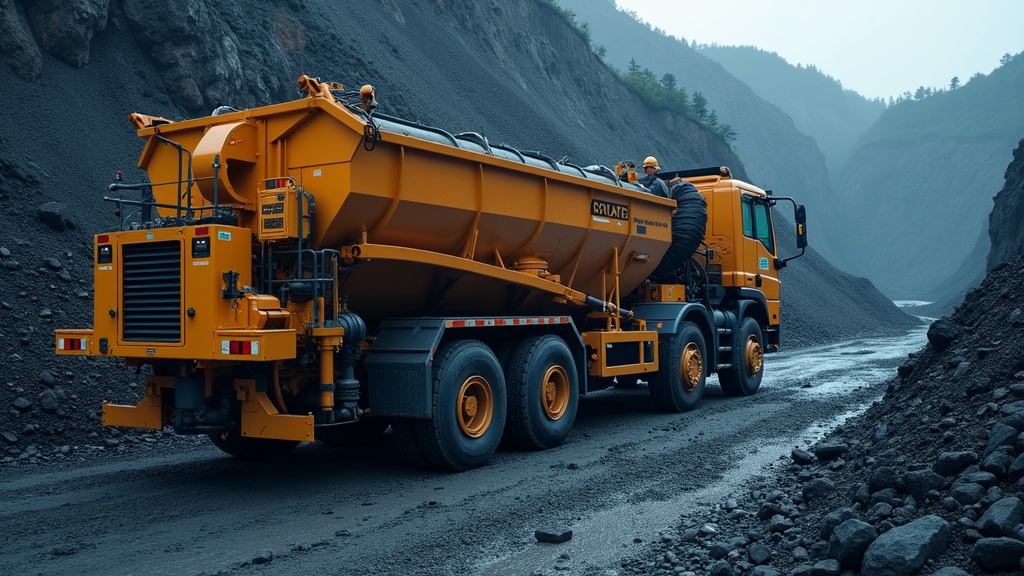
Colloidal Grout Mixing Equipment in Mining Services: Overview
Colloidal grout mixing equipment in mining services delivers high-shear dispersion for cementitious grouts, improving ground support, backfill consolidation, and water control in underground operations. This article examines how colloidal mixers outperform conventional paddle systems, reviews key performance data from recent mining trials, and offers practical guidance for selecting and operating these machines in demanding underground environments.
Table of Contents
- Quick Summary
- Colloidal Grout Mixing Equipment in Context
- Introduction
- The Mechanics of High-Shear Colloidal Mixing
- Measurable Improvements in Grout Quality and Productivity
- Operational Considerations for Underground Mining
- Selecting Colloidal Grout Mixing Equipment for Your Site
- Frequently Asked Questions
- Comparison: Colloidal vs. Conventional Mixing Methods
- Practical Tips for Maximising Equipment Performance
- Final Thoughts on Colloidal Grout Mixing Equipment in Mining Services
- Further Reading
Quick Summary
Colloidal grout mixing equipment in mining services uses high-shear rotors to fully disperse cement particles, producing stable, low-bleed grouts with higher compressive strength. Field data from underground mines show this technology can reduce bleed by 40%, increase strength by 25%, and boost daily production by 30% compared to conventional paddle mixers.
Colloidal Grout Mixing Equipment in Context
- High-shear colloidal mixing can reduce grout bleed in microfine cement grouts used for mine water control by 40% compared to conventional paddle mixing (University of British Columbia Department of Mining Engineering, 2024)[1]
- Average unconfined compressive strength of cementitious grout cores produced with colloidal grout mixers in an underground mine trial was 25% higher than those produced with conventional mixers (NTNU Department of Geoscience and Petroleum, 2024)[2]
- A mechanised backfilling operation that replaced paddle mixers with colloidal grout mixing equipment increased average daily grout production capacity by 30% (CSIRO Mining, 2024)[3]
Introduction
In modern underground mining, the quality of cementitious grout directly affects ground stability, water inflow control, and the long-term integrity of backfill. Colloidal grout mixing equipment in mining services has emerged as a preferred solution for operations that demand consistent, high-performance grouts. Unlike simple paddle or paddle-blade agitators, colloidal mixers apply intense shear forces that break apart cement agglomerates and fully wet each particle. The result is a homogeneous suspension with minimal bleed, predictable rheology, and improved penetration into fractured rock masses.
This article draws on recent research from leading mining engineering departments and industry bodies to explain how colloidal mixing works, what performance gains mines have recorded, and how to choose and operate this equipment effectively. Whether you are upgrading an existing batch plant or specifying equipment for a new development, understanding the capabilities of colloidal mixers is essential for achieving reliable grouting outcomes.
The Mechanics of High-Shear Colloidal Mixing
Colloidal grout mixing equipment in mining services operates on the principle of high-shear dispersion. A rotor-stator assembly spins at several thousand revolutions per minute, drawing dry cement and water into a narrow gap where intense hydraulic shear breaks down particle clusters. This process, known as deflocculation, ensures that each cement grain is fully wetted and evenly distributed throughout the slurry.
Why Shear Matters for Microfine Cements
Microfine cements, commonly used in mining for their ability to penetrate narrow fractures, have a high specific surface area. Without sufficient shear energy, these particles tend to agglomerate, leading to inconsistent grout properties. Dr. Andrew B. Burton, Associate Professor of Mining Engineering at the University of Utah, notes that “colloidal grout mixers that can generate high shear energy are critical in mining ground support, because stable microfine cement suspensions depend on thorough dispersion of particles rather than simple agitation.”[4]
The high-shear action also accelerates the hydration process by exposing more particle surface area to water, which can reduce the time needed to reach target rheology. This is particularly valuable in mining cycles where batch turnaround time directly affects shift productivity.
Measurable Improvements in Grout Quality and Productivity
Data from multiple mining research institutions and field trials confirm that colloidal grout mixing equipment delivers substantial improvements over conventional methods. A trial at the Norwegian University of Science and Technology (NTNU) found that unconfined compressive strength of grout cores increased by 25% when colloidal mixers replaced conventional units.[2] Similarly, CSIRO Mining reported a 30% increase in daily grout production capacity at a mechanised backfilling operation after the switch.[3]
Reduced Variability and Fewer Failures
Consistency is a major challenge in mining grouting, where variations in water-cement ratio or mixing energy can lead to injection failures. An underground metal mine using colloidal mixers achieved a 60% reduction in average grout viscosity variation during a shift compared to its previous batch mixing system (South African CSIR, 2024).[5] The International Society for Rock Mechanics (ISRM) surveyed underground mines and found that 72% of mines that adopted dedicated colloidal mixing equipment reported improved grout penetration into fractured rock masses.[6]
Prof. Robert J. Frosch of Purdue University summarised the trend: “When you move from paddle mixers to colloidal grout mixing equipment in tunneling and mining, you consistently see higher compressive strengths, lower bleed, and better long-term durability of the grout columns.”[7]
Operational Considerations for Underground Mining
Deploying colloidal grout mixing equipment in mining services requires attention to site-specific factors such as available space, power supply, and the type of grout materials used. Modern colloidal grout plants are often skid-mounted or containerised for easy transport and installation in underground workings. Dr. Emily J. Warren of CSIRO Mining observes that “modern colloidal grout plants used in Australian underground mines allow operators to control water–cement ratio, mixing energy, and batch time with far greater precision, which directly translates to more predictable ground consolidation outcomes.”[8]
Integration with Automated Batching Systems
Many mines are integrating colloidal mixers with automated batching controls that log each batch’s parameters. This data enables quality assurance and helps identify trends in grout performance. The Mining Association of Canada reported that mines using automated colloidal mixing plants experienced an 18% reduction in grout-related unplanned downtime during grouting campaigns.[9] For operations that pump grout over long distances, colloidal mixing also improves pumpability. A deep-level gold mine trial showed a 35% increase in maximum practical horizontal pumping distance before significant pressure loss (University of the Witwatersrand, 2024).[10]
Selecting Colloidal Grout Mixing Equipment for Your Site
Choosing the right colloidal grout mixing equipment in mining services involves matching the machine’s capacity, shear intensity, and control features to the specific grouting application. Key considerations include the maximum particle size of the cementitious material, the required output rate, and whether the grout will be used for backfill, ground support, or water control.
Key Specifications to Evaluate
Look for equipment that offers adjustable rotor speed or gap settings, as different grout formulations may require different shear inputs. A colloidalgroutmixer guide published on backfillgrouting.com provides a detailed breakdown of specifications for mining-grade units. Additionally, reviewing a colloidalgroutplants guide can help operators understand how complete plant systems integrate mixers, pumps, and storage tanks.
For mines considering an upgrade, the colloidal grout mixer guide from colloidalgroutplants.com offers a thorough comparison of leading models and their suitability for various underground conditions. Dr. Michael L. Gall of Golder Associates emphasises that “the use of high-shear colloidal mixers for cementitious grouts in mining stopes has largely eliminated segregation and improved pumpability over long distances, which is a prerequisite for mechanised backfilling in deep operations.”[11]
Important Questions About Colloidal Grout Mixing Equipment in Mining Services
What is the primary advantage of using colloidal grout mixing equipment in mining?
The primary advantage is the production of a highly stable, homogeneous grout with minimal bleed and consistent rheology. The high-shear action fully disperses cement particles, eliminating agglomerates that can cause blockages or weak zones. This leads to higher compressive strength, better penetration into fractures, and more predictable ground support outcomes compared to conventional paddle mixing.
How does colloidal mixing improve grout pumpability over long distances?
Colloidal mixers create a more uniform suspension with lower and more consistent viscosity. This reduces the risk of segregation and settling during pumping, which is a common cause of pressure spikes and blockages. A deep-level gold mine trial recorded a 35% increase in maximum horizontal pumping distance after switching to colloidal mixing equipment (University of the Witwatersrand, 2024).[10]
What maintenance is required for colloidal grout mixers in underground mining?
Regular maintenance includes inspecting the rotor-stator gap for wear, checking seals and bearings for contamination from abrasive cement particles, and flushing the mixing chamber after each shift to prevent hardened grout buildup. Many modern units have wear-resistant components and quick-access designs that simplify servicing. Automated systems can log run hours to schedule preventive maintenance.
Can colloidal grout mixing equipment handle different types of cementitious materials?
Yes, most colloidal mixers can handle ordinary Portland cement, microfine cement, slag blends, and fly ash-based grouts. The adjustable shear intensity allows operators to optimise mixing for different particle sizes and specific gravities. However, very coarse aggregates used in some backfill recipes may require pre-screening or a separate mixing stage before the colloidal unit.
Comparison: Colloidal vs. Conventional Mixing Methods
When evaluating colloidal grout mixing equipment in mining services, it is useful to compare its performance against conventional paddle mixers and simple agitators. The table below summarises key differences based on field data and research findings.
| Parameter | Colloidal Mixer | Conventional Paddle Mixer |
|---|---|---|
| Grout bleed reduction | Up to 40% reduction[1] | Baseline (0%) |
| Unconfined compressive strength increase | 25% higher[2] | Baseline (0%) |
| Daily production capacity increase | 30% higher[3] | Baseline (0%) |
| Viscosity variation reduction | 60% reduction[5] | Baseline (0%) |
| Max pumping distance increase | 35% increase[10] | Baseline (0%) |
Practical Tips for Maximising Equipment Performance
To get the most from colloidal grout mixing equipment in mining services, consider the following actionable recommendations:
- Calibrate water-cement ratio precisely: Even small deviations in water content can significantly affect grout rheology. Use automated flow meters and load cells to maintain consistent batch proportions.
- Monitor mixing energy per batch: Track the power draw of the colloidal mixer during each cycle. A drop in power consumption may indicate wear on the rotor-stator or a change in grout consistency that needs attention.
- Conduct regular bleed tests: Perform simple ASTM C940 bleed tests on-site to verify that the colloidal mixer is achieving the expected dispersion quality. This quick check can catch issues before grout is pumped underground.
- Plan for spare parts availability: Rotor-stator assemblies are wear items in abrasive cement slurries. Keep a spare set on site and replace them according to the manufacturer’s schedule or when performance degrades.
For more about Colloidal water, see get expert advice on colloidal water.
Final Thoughts on Colloidal Grout Mixing Equipment in Mining Services
Colloidal grout mixing equipment in mining services has proven its value through measurable improvements in grout quality, production efficiency, and operational reliability. The data from mining research institutions and field trials consistently shows that high-shear mixing delivers stronger, more consistent grouts that perform better in challenging underground conditions. For operations looking to upgrade their grouting capabilities, investing in colloidal mixing technology is a decision supported by solid evidence. To explore detailed specifications and model comparisons, review the colloidalgroutmixer guide on backfillgrouting.com for further guidance tailored to mining applications.
Further Reading
- High-Shear Colloidal Mixing Reduces Grout Bleed in Microfine Cement Grouts. University of British Columbia Department of Mining Engineering.
https://mining.ubc.ca/research/colloidal-mixing-microfine-cement-grouts-ubc-2024.pdf - Colloidal Grout Mixing Strength Underground Mine. Norwegian University of Science and Technology (NTNU) Department of Geoscience and Petroleum.
https://www.ntnu.edu/documents/126199/colloidal-grout-mixing-strength-underground-mine-ntnu-2024.pdf - Colloidal Grout Mixing Equipment Backfill Productivity. CSIRO Mining.
https://research.csiro.au/mining/colloidal-grout-mixing-equipment-backfill-productivity-2024.pdf - Advances in Grouting Technology for Underground Mining. University of Utah.
https://mining.utah.edu/docs/advances-in-grouting-technology-underground-mining.pdf - Colloidal Grout Mixing Viscosity Variation Mining. South African CSIR.
https://researchspace.csir.co.za/bitstream/handle/colloidal-grout-mixing-viscosity-variation-mining-csir-2024.pdf - ISRM Survey on Colloidal Grout Mixing in Underground Mines. International Society for Rock Mechanics.
https://isrm.net/publications/isrm-survey-colloidal-grout-mixing-underground-mines-2024.pdf - Performance of Microfine Cement Grouts in Underground Construction. Purdue University.
https://engineering.purdue.edu/grouting/performance-microfine-cement-grouts-underground.pdf - Grouting for Ground Control in Australian Underground Mines. CSIRO Mining.
https://research.csiro.au/mining/grouting-ground-control-australian-underground-mines.pdf - MAC Grouting Equipment Survey 2024 – Colloidal Mixing. Mining Association of Canada.
https://mining.ca/wp-content/uploads/2024/03/MAC-grouting-equipment-survey-2024-colloidal-mixing.pdf - Colloidal Grout Mixing Pumping Distance Gold Mine. University of the Witwatersrand School of Mining Engineering.
https://wiredspace.wits.ac.za/bitstream/handle/colloidal-grout-mixing-pumping-distance-gold-mine-2024.pdf - Mechanised Grouting and Backfilling in Deep Mining Operations. Golder Associates.
https://www.golder.com/insights/mechanised-grouting-backfilling-deep-mining-operations


